Meridian, ID
Broken Garage Door Spring Repair in Meridian
The most common call we take, and the one job on a door that genuinely hurts people. Measured and matched to your door rather than fitted from whatever is on the van.
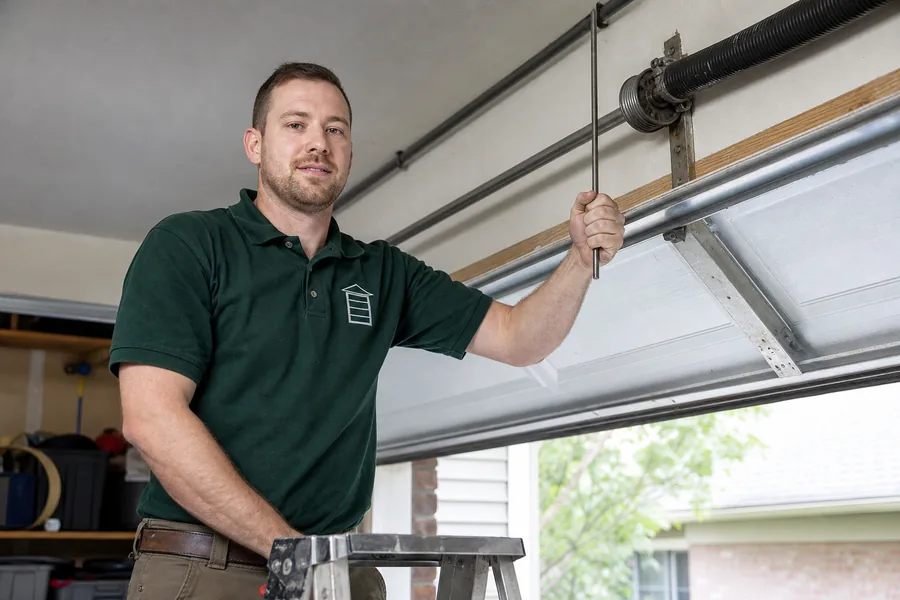
The most common call we take, and the one job on a door that genuinely hurts people. Measured and matched to your door rather than fitted from whatever is on the van.
Most broken garage door spring repair calls we take in Meridian start the same way - the door moved fine yesterday. That is normal. The components that fail are load-bearing, and load-bearing parts fail suddenly rather than gradually. In Meridian, dry cold and fine dust that works into roller bearings, which is why we carry the parts for it on the van rather than ordering them in.
Lift a garage door with the spring disconnected and you understand the whole system in about two seconds. It is 130 to 190 pounds of steel on a double, and considerably more insulated. The torsion spring above the opening is wound to store almost exactly that much energy, so the two cancel and the door floats. The half-horsepower motor on the ceiling is a positioning device for a weightless object. Take the spring out of that equation and the motor is asked to deadlift something it was never rated for.
The van covers Meridian and Boise, Eagle, Nampa, Kuna daily. You get a two-hour window rather than a day, a free written estimate, and a price that does not move between the driveway and the invoice.
The sound is unmistakable if you were home for it - a single flat bang, like a heavy book dropped on a concrete floor. Most people are asleep when it happens, because the metal contracts as the garage cools overnight and that is when a spring at the end of its life gives up.
If any of that matches, a technician can diagnose it on site in about ten minutes. We do not guess at it down the phone, and we do not charge to look.
There is one job on a residential garage door that sends people to hospital, and this is it. The energy in a wound spring does not dissipate because the spring has broken - the remaining half is still loaded, and the set screws holding it are the only thing in the way. Undone without winding bars properly seated, that load leaves in a fraction of a second and takes fingers with it. Adjustable wrenches and screwdrivers are not winding bars.
There is no safe way to keep using it, and there is no prize for trying. Load that should be on the counterbalance goes somewhere else instead - hinges, brackets, the opener's gear - and each of those is a bigger bill than the part that actually failed.
If the car has to come out, do it with the door fully down and the opener released. A partly-raised door with no working spring will finish the journey by itself.
None of this involves touching anything under tension, and all of it makes the phone call shorter and the estimate more accurate. Two minutes in the garage with the door down is enough.
Whatever you find, do not try to correct it. The value is in the description you give us, not in the repair - a technician arriving in Meridian who already knows what failed arrives with the right part on the van.
Two quotes for the same job in Meridian can differ by a lot and both be honest, because they are not for the same work. This is what ours includes as standard.
The last two items are the ones most commonly skipped, and they are the ones that matter. A door that has not been balanced by hand and had its reversal tested has been repaired, not finished.
Garage door failures are not spread evenly through the year, and in Meridian they cluster predictably enough to plan around.
Cold months take the springs. Steel loses a little ductility as the temperature drops, so a spring already near the end of its cycle life fails on a cold morning rather than a mild afternoon.
Warm and stormy months take everything else - seals crack, lubricant thins and runs off the coils, and wind-driven grit works into roller bearings and track. In Meridian that matters more than the national averages allow for, because dry cold and fine dust that works into roller bearings.
The useful conclusion is about timing rather than parts: service the door before the season that breaks it, not after.
It almost never does. The spring is a consumable part on a door that lasts twenty to thirty years, and replacing it is a parts-and-labor job on a door that is otherwise sound. Anyone who leads with a replacement quote before looking at the panels is selling, not diagnosing.
A spring that is too strong is as wrong as one that is too weak - the door creeps open on its own, the opener fights it on the way down, and the safety reversal stops working correctly. The spring is matched to the door's actual weight, not upgraded past it.
You can, and we will if that is what you want. But both springs were wound the same number of cycles on the same day, so the second one is not far behind, and you pay the call-out and the labor twice. We quote both and let you choose with the numbers visible.
None of that is unique to Meridian. It is simply what happens when a door is quoted over the phone by somebody who has not seen it, and it is the reason we do not give prices before a technician has stood in front of the door.
Nothing here is an upsell. Each one genuinely changes what the work involves, and each one has to be looked at rather than assumed.
| Factor | Why it matters |
|---|---|
| Cycle rating | A 10,000-cycle spring and a 25,000-cycle spring are different parts at different prices. On a door opened six times a day the second one is the cheaper choice over its life. |
| Door age | On a door old enough that panel sections are no longer made, we will say so before you spend on a spring. |
| Door weight | A single door, a double, and an insulated double are three different spring specifications. The technician weighs or calculates it rather than eyeballing it. |
| Collateral damage | A spring that let go can take a cable, a drum or a bearing plate with it. That is found on the visit and quoted before it is done. |
| Torsion versus extension | Older doors with springs along the side tracks are a different job, and safety cables are non-negotiable on them. |
That is the whole list. There is no separate call-out, no diagnostic charge and no paperwork fee waiting at the end of it.
A quote well below everybody else is almost always one of three things, and it is worth knowing which before you take it.
It is a builder-grade part where a better one costs a little more - the classic being a 10,000-cycle spring on a door that is opened six times a day, which puts you back where you started in about four years.
It is one side of a two-side job, leaving the second spring or the second cable to fail a few weeks later and the labor to be paid twice.
Or it is a phone number rather than a price, with the real figure arriving once the technician is in your garage and your car is behind a door that will not move.
None of that means the lowest quote is wrong. It means the three questions worth asking are: what is the part, is it both sides, and is this price fixed.
Asked on nearly every visit, and the answer is rarely the one people expect - most doors that look finished are not, and a few that look fine are.
| Situation | What we recommend |
|---|---|
| Wooden door that has begun to swell and bind | Depends entirely on the frame. Worth a look before you commit to either. |
| Door works but is deafening | Repair. Nylon rollers, new hinges and a proper service usually solve it. |
| Door is off its track after an impact | Repair first. Realign, find the cause, and only then judge whether panels are sound. |
| Opener over fifteen years old, board failed | Replace the opener only. A modern head is quieter and carries its own warranty. |
| Spring, cable or roller failure on sound panels | Repair. These are consumable parts on a door with decades of life left in it. |
| Repairs arriving more than once a year | Replace. You are paying for a new door in installments and not getting one. |
If you are somewhere in between, ask for both numbers. We will quote the repair and the replacement on the same visit at no charge, and you can decide with two real figures rather than an opinion.
You do not need tools and you do not need to touch anything under tension. Stand in the garage with the door shut and look at four things.
The springs above the door: any orange-brown bloom on the coils is surface rust, and surface rust is where the spring will eventually break. The gap in a broken spring is obvious once you know to look for it.
The cables running down each side: follow them to the bottom brackets and look for strands standing proud of the lay of the wire. Frayed is the warning; snapped is the emergency.
The rollers: spin one with a finger. It should turn freely. A roller that will not turn is dragging in the track and taking the track with it.
And the balance: release the opener with the door down, lift by hand to waist height, and let go. It should stay. Anything else means the counterbalance needs setting.
Yes - card, and we issue a written invoice for every job. Nothing is cash-only and nothing is priced on the doorstep.
If a spring or cable has failed, no. Leave it down and do not force it. The counterbalance holds a great deal of stored energy and it can let go without warning.
On a two-spring door both springs went up on the same day and have done the same work since. When one breaks, the other is not fine - it is at the same point in the same life, typically weeks from the same end. That is why the estimate shows both. Take one if you prefer, and the second call-out is on you rather than a surprise.
A residential torsion spring is rated in cycles, not years. The standard spring supplied with most doors is a 10,000-cycle spring, and one cycle is one trip up and one trip down. A household that opens the door four times a day uses about 1,460 cycles a year, so the arithmetic gives seven years. A household with two working adults and a teenager can double that rate and see the spring go in three.
Yes, in writing, on parts and labor. If the same fault returns inside the warranty period we come back and put it right at no charge.
Yes - LiftMaster, Chamberlain, Genie, Craftsman, Clopay, Amarr, Wayne Dalton and the rest. The mechanisms are common across brands and we carry parts for all of them.
If the door in your Meridian garage is doing any of the things on this page, the fastest route to an answer is a phone call. Describe what it is doing and you will get a straight opinion on whether it needs somebody today or whether it can wait.
No call center, no booking fee, and no charge for the visit or the estimate. We cover Meridian and Boise, Eagle, Nampa, Kuna.
Name, number and what the door is doing is enough. Everything before the price is agreed costs you nothing, across the whole of Ada County.
Prefer to talk it through? Call (208) 953-9709.
Motor runs, door does nothing? That is a stripped nylon gear, and a gear kit costs a fraction of a new opener. We diagnose before we sell.
What this costs and how fast →One corner dropped and the panel is out of the channel. Stop running the opener - each attempt drags more hinges and track out of line.
What this costs and how fast →Replaced in pairs, drums reset equally, and sealed nylon rollers where the originals were unsealed plastic. Quieter, and several times the life.
What this costs and how fast →A straight answer on the phone about whether it really needs somebody tonight, and the same parts and labor rates as a Tuesday morning.
What this costs and how fast →When the panels are past saving. Measured for headroom, track set plumb, counterbalance sized to the finished door - not to the invoice.
What this costs and how fast →